Weather is one of the main reasons people look at the Okanagan, and it is fair to ask about the hard parts too. This page covers winter snow, summer heat, wildfire smoke and what FireSmart means for a buyer. The figures come from Environment and Climate Change Canada averages and other official sources. It is an independent guide from a local real estate agent, not affiliated with any agency named below, and health notes are general information, not medical advice.
 Sean's insider tip
Visit in more than one season if you can. A summer trip shows you the lake and the heat, and a winter trip shows you the roads, the snow and the light.
What are Vernon winters like?
What are winters like in Vernon, B.C.?
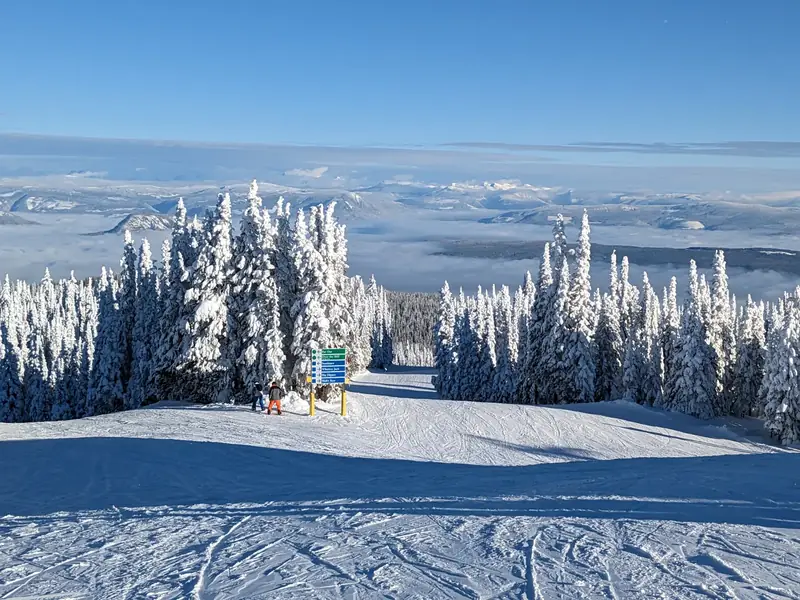
Vernon winters are cold but fairly mild for Canada: January averages about -3.5°C, with daytime highs near -0.5°C and overnight lows around -6.4°C.
Environment and Climate Change Canada's 1991 to 2020 normals show lows at or below freezing on roughly 29 January nights, and highs that stay at or below freezing on about 14 January days. Cold snaps do happen; the coldest reading in that 30-year period was -30.5°C, in January 1996. January snowfall averages about 28 cm, based on 1991 to 2007 snowfall records.
For perspective, the same federal normals put Edmonton's January average at -12.3°C.
Which month is the coldest in Vernon, BC?
January is Vernon's coldest month, with an average daily temperature of -3.5°C.
Environment and Climate Change Canada's 1991 to 2020 normals put December close behind at -3.0°C and February at -1.1°C. In January the average daytime high is about -0.5°C and the average overnight low is about -6.4°C. For contrast, July, the warmest month, averages 20.6°C, a swing of about 24 degrees across the year.
Those are 30-year averages, so any single winter can run colder or milder. The coldest reading recorded in that period was -30.5°C, in January 1996.
How much snow does Vernon get in a year?
Vernon averages about 93 cm of snow a year (92.8 cm), according to Environment and Climate Change Canada's 1991 to 2020 normals.
Most of it falls from November to March, with December (about 31 cm) and January (about 28 cm) the snowiest months. The same federal normals list roughly 139 cm at Calgary's airport, 127 cm at Edmonton's airport and about 37 cm at Vancouver's airport, so Vernon sits between the Lower Mainland and the Prairies.
Vernon's snowfall figure is based on 1991 to 2007 records from the Vernon Bella Vista station. Higher ground, like the ski hills, gets different weather, so check forecasts before you drive up.
Does Vernon get snow, and how does the city handle it?
Yes, Vernon gets regular snow from about November to March, and the City runs a priority-based plowing and sanding program.
Main roads, bus routes and school zones come first, then residential streets, then lanes and cul-de-sacs. The City says clearing residential streets can take up to 72 hours after a snowfall ends. Highways 97 and 6 through town are maintained by the province, not the City.
Owners or occupants are asked to clear the sidewalk beside their property within 24 hours of a snowfall. If it isn't cleared, a bylaw officer may step in and the cost could be charged to the owner. Piling snow on the road isn't allowed, and you clear your own driveway.
How hot do summers get?
What is the hottest month in Vernon?
July is Vernon's hottest month, with an average daytime high of 28.4°C and an average daily temperature of 20.6°C.
August is close behind, at a 27.9°C average high. Environment and Climate Change Canada's 1991 to 2020 normals count about 12 days above 30°C in July and about 12 in August, or 29 days in a typical year. Heat spikes go well beyond that: the hottest temperature recorded in that 30-year period was 39.5°C, in July 1994. A 39.3°C reading followed in June 2015.
Nights cool off a little, with the July average low about 12.7°C.
What is the average summer temperature in BC?
There is no single B.C. figure, because summer temperatures vary a lot by region; in Vernon the July average is 20.6°C, with an average daytime high of 28.4°C.
Environment and Climate Change Canada's 1991 to 2020 normals show Vernon averaging 17.0°C in June, 20.6°C in July and 20.0°C in August. Vancouver's airport station is cooler, at 15.8°C, 18.2°C and 18.2°C for the same months.
The Interior also has hot spells well above these averages, so treat them as a guide, not a forecast.
Has Canada ever hit 100 degrees?
Yes: Lytton, B.C. reached 49.6°C on June 29, 2021, about 121°F, which Environment and Climate Change Canada reported as a new Canadian record.
It broke the previous national record of 45°C, which had stood for 84 years. A reading of 100°F is about 37.8°C, a level Vernon has also passed: its federal normals list a highest reading of 39.5°C, in July 1994, for the 1991 to 2020 period.
Canadian forecasts use Celsius, so you will never see 100 on one. A 100°F day shows up as about 38°C.
How smoky does it get?
How bad is wildfire smoke in Vernon?
Wildfire smoke can make summer air unhealthy in Vernon, but it varies a lot from year to year and from day to day.
The City's 2024 wildfire plan notes that smoke is becoming more common across the Okanagan in fire season. B.C.'s Air Quality Health Index rates air from 1 to 10+ as low, moderate, high or very high risk, and includes a North Okanagan reading with a 48-hour forecast.
The BC Centre for Disease Control suggests a portable HEPA air cleaner in one room, visiting cooler public indoor spaces, and easier outdoor exercise on smoky days. Children, older adults, pregnant people and anyone with heart or lung conditions are at higher risk. Call 8-1-1 for health advice.
Why is it so smoky in Kelowna?
Kelowna gets smoky when wildfire smoke moves into the Okanagan, and it can change quickly from hour to hour.
The Province issues Air Quality Warnings by region. Kelowna falls in the Central Okanagan region, while Vernon sits in the North Okanagan region. A July 2026 warning noted that smoke conditions can change quickly over short distances and vary considerably hour by hour, so one neighbourhood can look clearer than another.
To see what is happening now, check the Air Quality Health Index and EmergencyInfoBC for fires near you, and see the Province's warnings page.
Is haze bad for your health?
Yes, wildfire haze can harm your health, because the smoke carries tiny particles that travel deep into your lungs.
The BC Centre for Disease Control says those particles cause irritation and inflammation until the air clears. Common effects are a sore throat, eye irritation, a runny nose, phlegm, wheezy breathing and headaches, which are usually mild. People with asthma, COPD, heart disease or diabetes, people who are pregnant, infants, small children and older adults are at higher risk.
Get medical help promptly for shortness of breath, severe cough, dizziness, chest pain or heart palpitations. Call 8-1-1 for advice.
Does wearing a mask help with haze?
A well-fitted respirator such as an N95 or KN95 can help with wildfire smoke, but cloth and surgical masks do not filter the fine smoke particles.
Interior Health says the mask must seal against your face with no gaps, or it will not work properly. The BC Centre for Disease Control also lists KF94 respirators. The BC Wildfire Service adds that N95s protect against particles only, not the gases in smoke, and calls respirators one tool among several, not a silver bullet.
The BC Centre for Disease Control's main advice is to reduce your exposure and find cleaner air, such as a room with a HEPA air cleaner. A respirator matters most if you need to be outdoors.
How to clear lungs from poor air quality?
B.C.'s health guidance doesn't offer a way to flush smoke out of your lungs; it focuses on getting to cleaner air and letting the irritation settle.
The BC Centre for Disease Control says smoke irritation and inflammation can last until air quality improves, and that most symptoms can be managed without medical attention. It suggests a portable HEPA air cleaner in one room, time in cooler public indoor spaces, easier outdoor exercise on smoky days, and drinking plenty of water to help reduce inflammation.
Call 8-1-1, see your primary care provider or visit a walk-in clinic for shortness of breath, severe cough, dizziness, chest pain or heart palpitations.
What about wildfire and FireSmart?
Is Vernon at risk of wildfire?
Yes, wildfire is a real summer risk in Vernon, and the City plans for it.
The City's 2024 wildfire resiliency plan points to hot, dry summers, growth along the forest edge, and lakeside areas such as Eastside Road and Adventure Bay that rely on one road in and out. In 2021 the White Rock Lake fire prompted evacuation alerts for Vernon; the 78 properties it destroyed were in Ewings Landing, Monte Creek and Killiney, outside the city.
An evacuation alert means be ready to leave on short notice; an order means leave immediately. Check the BC Wildfire Service for current fires, and sign up for the City's Alertable notices.
What does FireSmart mean for buying a home in Vernon?
FireSmart is a national program for reducing wildfire risk to homes, so for a buyer it means looking at the house and the land around it, not just the inside.
Look at roofing and siding, gutters and decks, and what grows close to the house. The City's FireSmart tips include a 1.5 m non-combustible zone around the house and deck, grass kept under 10 cm and pruned trees.
The City offers property assessments, but currently has a wait list, and it says it has no grants or rebates for homeowners. A free self-assessment is available through FireSmart BC. The Regional District of North Okanagan runs 2026 FireSmart programs for its electoral areas, so outside the city, ask which applies.
 A question for you
Which season matters most to you: ski winters, lake summers or something in between? Tell Sean or Sarah and they can suggest areas that suit.
Related guides
- What it's like to live in Vernon
- Vernon neighbourhoods: where to start
- Buying a home in B.C. when you're moving from out of province
- Moving to B.C.: the checklist
- Getting around Vernon without the guesswork
Updated October 28, 2026. Published by Sean Phillips, REALTOR®, Coldwell Banker Executives Realty. General information from official sources, not legal, tax, immigration or medical advice.
Get Sean's free Vernon move plan
Tell Sean where you're coming from and when you're thinking of moving. You'll get a short, personal plan: neighbourhoods that fit, what homes in your range look like right now, and a timeline that works with your move.
Thinking about the move?
Start with Sarah, Sean's AI assistant, any time of day for quick answers about neighbourhoods, listings and the area. When you're ready for real advice on where to buy, pricing or timing, book a free 10-minute Zoom chat with Sean.
How it works, in under a minute: Sarah answers your first questions any time, and Sean takes over when you're ready for advice.
Sources for this page
- Environment and Climate Change Canada, Canadian Climate Normals 1991-2020, Vernon (composite) (accessed Oct 28, 2026)
- Environment and Climate Change Canada, Canadian Climate Normals 1991-2020, Edmonton (Airport) (accessed Oct 28, 2026)
- ECCC Climate Normals 1991-2020, Calgary (Airport) (accessed Oct 28, 2026)
- ECCC Climate Normals 1991-2020, Vancouver International (Airport) (accessed Oct 28, 2026)
- City of Vernon, Snow and ice control (accessed Oct 28, 2026)
- Canada's top 10 weather stories of 2021, Environment and Climate Change Canada (accessed Oct 28, 2026)
- B.C. Government, Air Quality Health Index (accessed 2026-10-27)
- BC Centre for Disease Control, Wildfire Smoke (accessed 2026-10-27)
- City of Vernon, Community Wildfire Resiliency Plan 2024 (PDF) (accessed 2026-10-27)
- Air quality warning in effect for wildfire smoke (July 23, 2026), Province of B.C. (accessed 2026-10-27)
- Air Quality Warnings, Province of B.C. (accessed 2026-10-27)
- Tips to protect yourself from poor air quality and wildfire smoke, Interior Health (July 2026) (accessed 2026-10-27)
- Reducing exposure: respiratory protection, BC Wildfire Service (Sept 2024) (accessed Oct 28, 2026)
- BC Wildfire Service (accessed Oct 28, 2026)
- EmergencyInfoBC, Stages of Evacuation (accessed Oct 28, 2026)
- City of Vernon, Emergency Management (accessed Oct 28, 2026)
- City of Vernon, FireSmart (accessed Oct 28, 2026)
- City of Vernon, If you haven't already, now is the time to FireSmart your property (Aug 2023) (accessed Oct 28, 2026)
- RDNO, Electoral Area Residents Encouraged to Register for RDNO 2026 FireSmart Programs (accessed Oct 28, 2026)
- B.C. Government, FireSmart (accessed Oct 28, 2026)